Loading
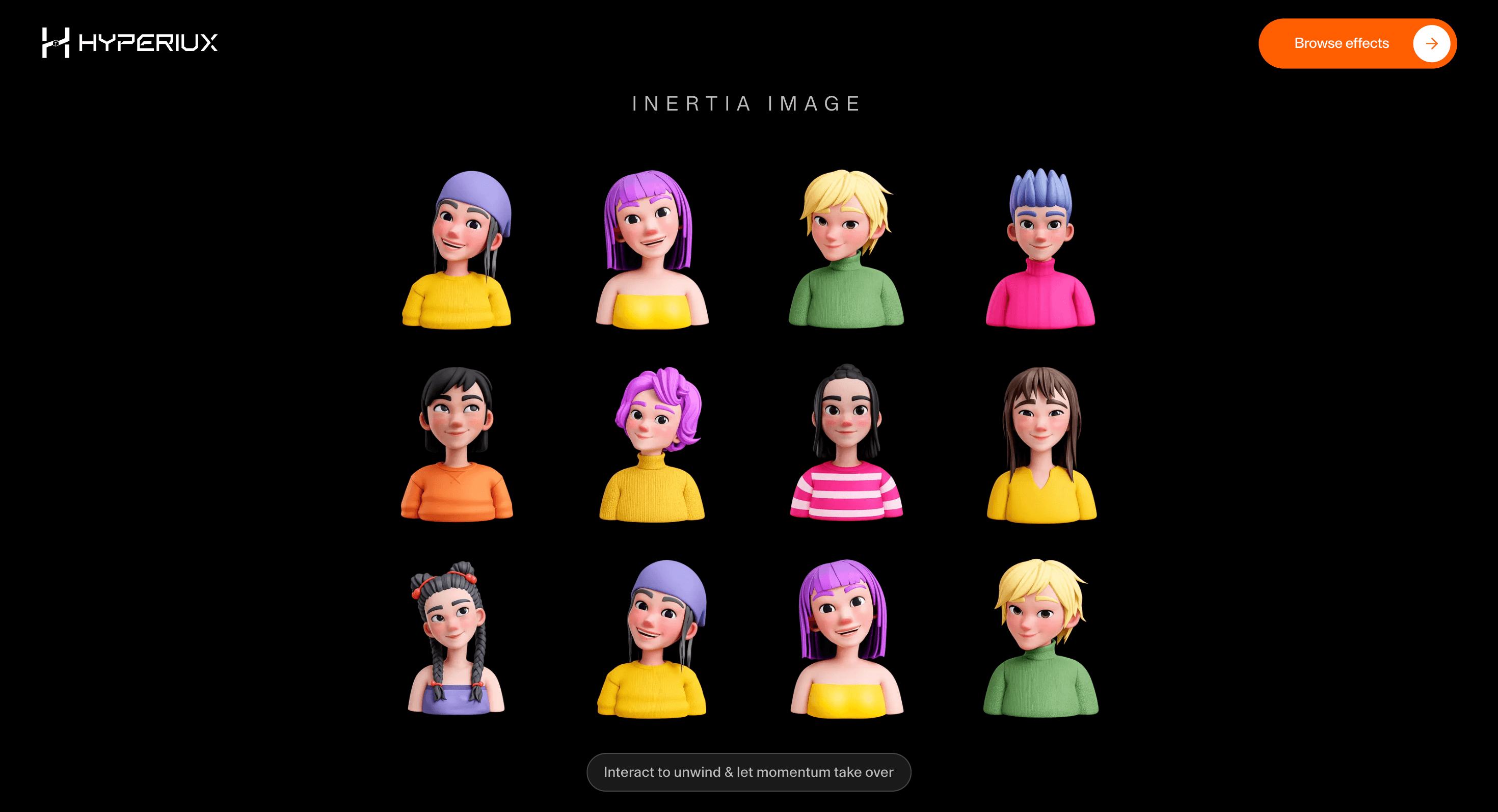
Inertia Image
A weighted image-follow cursor effect where preview visuals trail the pointer with delayed motion.
Published On: June 4, 2026
Last Updated: August 17, 2026
GSAP
Overview
Inertia Image turns pointer movement into atmosphere: images follow movement with weight.
Use it on creative homepages, portfolios, campaign pages, and brand experiments where the cursor can carry the visual language. Keep it off dashboards, checkout, forms, and utility-heavy product screens.
The risk in production is restraint. Treat the cursor layer as throwaway: switch it off on touch, keep focus states visible, and let nothing about clicking depend on it. If the page falls apart once you remove the effect, the cursor was doing work it should not own.
Install Command
This is a Pro Effect.
You can preview it now. Upgrade to Pro for instant install access.
Usage Code
This is a Pro Effect.
You can preview it now. Upgrade to Pro for instant install access.
Component Code
This is a Pro Effect.
You can preview it now. Upgrade to Pro for instant install access.
This is a Pro Effect.
You can preview it now. Upgrade to Pro for instant install access.
Example Production Use Case
Use this as cursor-system implementation guidance. Verify the shipped component export, pointer-tracking model, coarse-pointer disablement, z-index behavior, focus safety, cleanup, and reduced-motion handling before relying on exact props, defaults, imports, or installation steps.
Best Used For
- Portfolio indexes where preview images can follow movement with physical weight.
- Desktop browsing moments where the trail previews work without replacing project cards.
- Inertia Image gives pointer movement a brand role without hiding core controls or content.
Not For
Not for dashboards, checkout, forms, dense product UIs, or any flow where precision beats atmosphere.
Performance Budget
Use one cursor layer, throttle movement with requestAnimationFrame, avoid full-screen filter effects, and disable Inertia Image on coarse pointers.
Accessibility and Mobile
Switch it off for coarse pointers and leave touch native; anything revealed by the cursor needs a visible or tap-accessible alternative.
Common Mistakes
- Letting Inertia Image cover focus rings or clickable controls.
- Forgetting to disable the effect on coarse pointers.
- Hiding useful content behind mouse-only movement.
Changelog
v1.1.0
Jul 22, 2026reduce-motion applied
v1.0.0
Jun 4, 2026Initial release
Props
| Prop | Type | Default | Description |
|---|---|---|---|
strength | number | 1 | Pointer inertia velocity multiplier. |
rotation | number | 0 | Maximum image rotation while moving. |
scale | number | 1 | Hover scale applied to images. |
duration | number | 0.4 | Motion smoothing duration. |
Frequently Asked Questions
When should I use Inertia Image?
Use it when a creative or portfolio page needs images following movement with weight not on utility flows.
Does Inertia Image work on mobile?
Disable it on coarse pointers with CSS and JS pointer queries, then provide native touch behavior.
Can Inertia Image reveal important content?
Only when the same content is visible or accessible without pointer movement. Cursor-only reveals are not suitable for critical information.
How should Inertia Image behave around links and buttons?
Native click targets, visible focus, hover states, and modal stacking all have to keep working underneath it.
What should reduced motion do for Inertia Image?
Disable trails, lag, ripples, and pointer-following motion, then return to the native cursor.
Request a Custom Cursor Animation
Need a custom effect? Tell us what to create.


